AI in Healthcare at the Heart of EU Policymaking
- Prof. Liesbet Geris presented to the European Parliament's SANT Committee on AI and digital technologies in healthcare, covering cardiovascular models, digital twins, AI-assisted insulin management, pharmacogenomics, and rare disease simulations.
- Highlighted that AI's success depends on regulatory clarity, reliable data, professional training, and coordinated EU support.
- Challenges include overlapping frameworks (AI Act, MDR, GDPR, EHDS), liability, data quality, and SME investment barriers.
- Initiatives like the Virtual Human Twin aim to create a connected EU digital health ecosystem, improving patient care and competitiveness.
REACH Revision: Regulatory Scrutiny Board Issues Negative Opinion
- The RSB issued a negative opinion on the planned REACH revision under the 2020 Chemicals Strategy for Sustainability.
- Commissioner Jessika Roswall confirmed the proposal will be re-examined; timeline impact remains unclear.
- Debate highlighted potential ambiguity due to dual objectives of simplification and innovation.
- DG GROW noted that the revision integrates multiple options under the simplification agenda; further RSB reasoning expected soon.
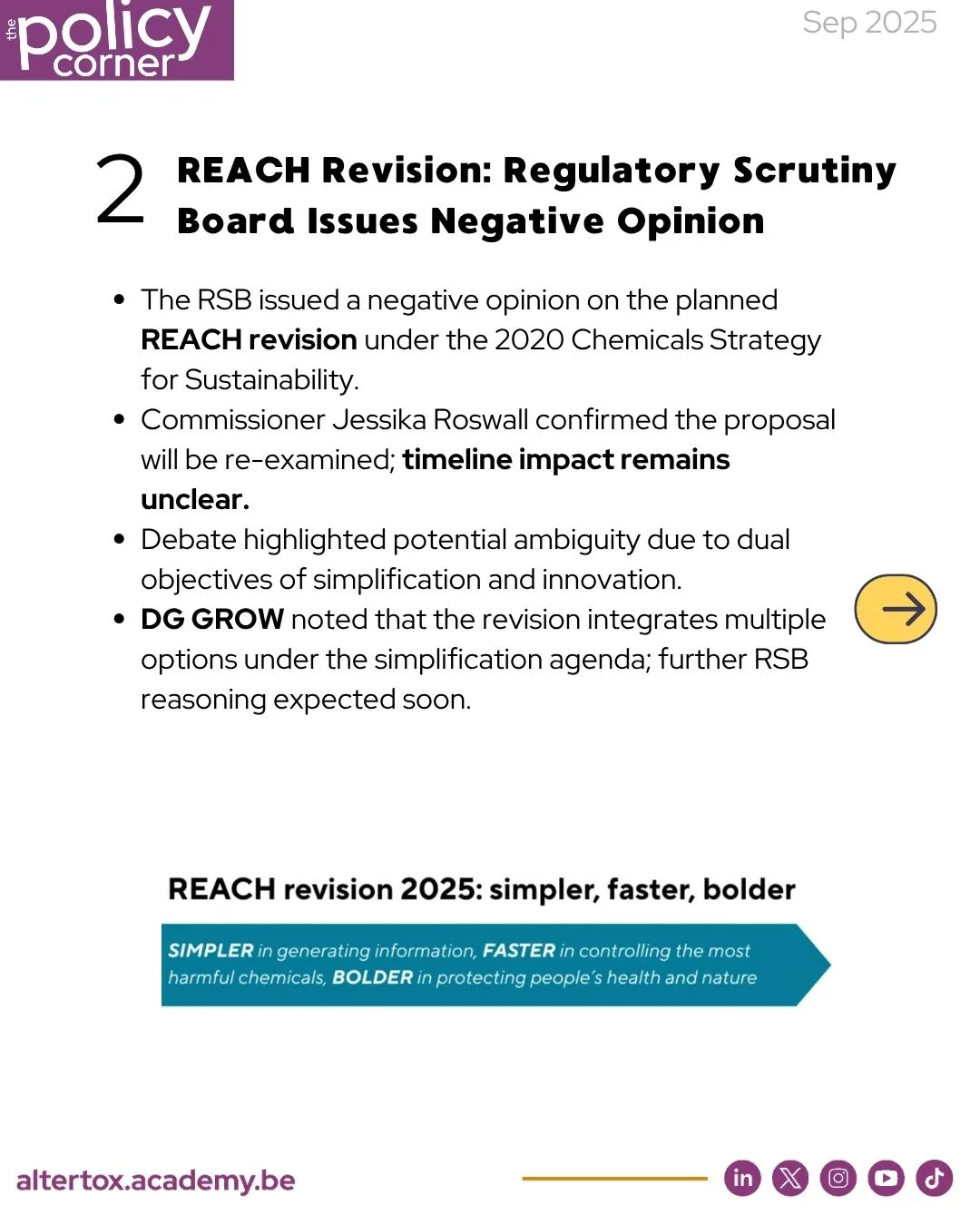
- REACH revision 2025: simpler, faster, bolder SIMPLER in generating information, FASTER in controlling the most harmful chemicals, BOLDER in protecting people's health and nature
- REACH revision 2025: simpler, faster, bolder. SIMPLER in generating information, FASTER in controlling the most harmful chemicals, BOLDER in protecting people's health and nature.
Exchange of views on European Commission's Life Sciences Strategy
- Presented by Commissioners Zaharieva and Várhelyi to position Europe as a global leader by 2030.
- Includes multi-country trials, European Innovation Council support, Biotech Act, €300M for vaccine/cancer procurement, and the "Choose Europe" talent campaign.
- €500M allocated for talent programs; EU funding, private investment, EIB support, and AI tools to strengthen competitiveness.
- MEPs raised questions on funding, rare diseases, patents, medical devices, staff shortages, and equitable access.
Parliamentary Question - E-003434/2025: Aligning EU Initiatives on Non-Animal Methods
- On 5 September 2025, MEPs Sebastian Everding and Anja Hazekamp asked how the Commission will align EU initiatives advancing non-animal methods, including:
- The roadmap to phase out animal testing in chemical safety
- April 2024 revision of pharmaceutical legislation
- ERA 2025-2027 policy agenda for biomedical research and regulatory assessment of medicines and devices
- The MEPs requested clarity on ensuring synergies, implementing concrete measures (e.g., guidance, scientific forums), and monitoring outcomes to maintain alignment with pharmaceutical frameworks.
Parliamentary Question - E-002468/2025: Non-Protected Organisms and NAMs in REACH
- MEP Jutta Paulus asked about the use of non-traditional models (Daphnia, C. elegans, Drosophila, zebrafish, frog embryos) to advance NAMs in chemical safety.
- The Commission confirmed no plans to expand protected species under Directive 2010/63/EU; Member States must minimize pain/harm.
- A roadmap to phase out animal testing covering non-vertebrates and early vertebrate life stages is expected by early 2026.
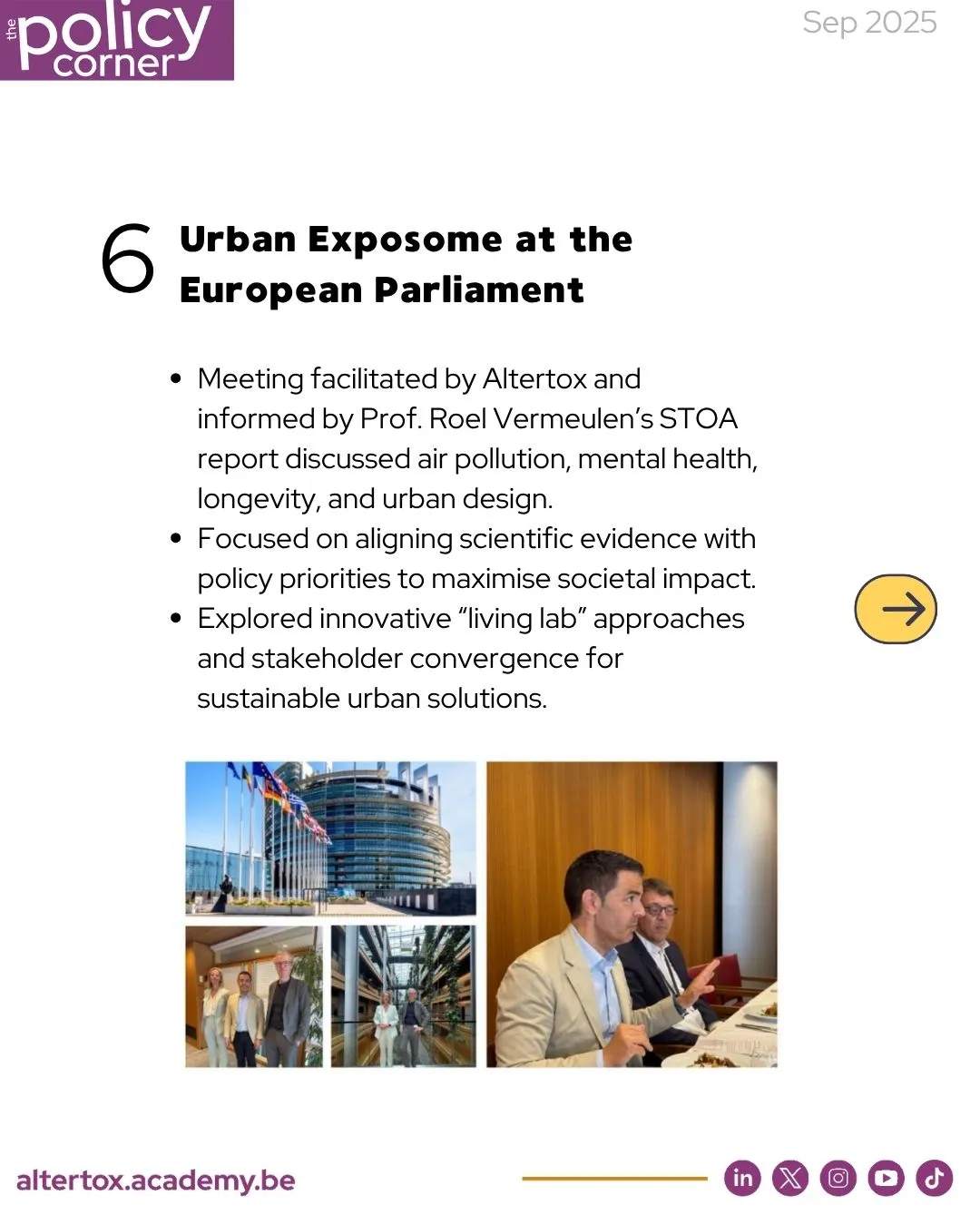
Urban Exposome at the European Parliament
- Meeting facilitated by Altertox and informed by Prof. Roel Vermeulen's STOA report discussed air pollution, mental health, longevity, and urban design.
- Focused on aligning scientific evidence with policy priorities to maximise societal impact.
- Explored innovative "living lab" approaches and stakeholder convergence for sustainable urban solutions.
Targeted Revision of EU Rules for Medical Devices and In Vitro Diagnostics
- The European Commission launched a public call for evidence to simplify regulations while maintaining patient safety and innovation.
- Aims to improve competitiveness, reduce dependencies, and ensure cost-efficient safety requirements.
- Feedback open until 6 October 2025; proposal expected Q4 2025.
Biotech Act: Accelerating Innovation from Lab to Market
- Public consultation open until 10 November 2025 to support EU biotech innovation from lab to industrial scale.
- Focus on regulatory streamlining, research-driven innovation, and support for startups, SMEs, and non-profits.
- Proposal adoption expected in Q3 2026.
Open Letter from MEPs to the Commission: Innovation Without Cruelty
- NGOs and MEPs urge the Commission to defend cosmetics testing bans, promote NAMs, and deliver an EU-wide roadmap to phase out animal testing.
- Calls for decisive action to protect animals, advance human-relevant science, and secure EU leadership in humane innovation.
ENKORE Calls for Stronger Action on Endocrine Disruptors in REACH Revision
- EDs pose serious health risks with links to cancers, reproductive and metabolic disorders, and cognitive impacts and annual societal costs of €163B.
- Regulation remains slow and fragmented.
- ENKORE recommends:
- extending the generic risk management approach to all identified EDs,
- updating standard REACH information requirements to test for ED effects at all tonnage levels, and
- introducing a Mixture Assessment Factor (MAF) to address combination effects
NIH Establishes First Dedicated Organoid Center to Reduce Reliance on Animal modelling
- The Standardized Organoid Modeling (SOM) Center ($87M over 3 years) will develop human-based organoid models to reduce reliance on animal testing.
- Will utilize AI, robotics, and diverse human cell sources to create reproducible, regulatory-acceptable models for drug discovery and translational research.
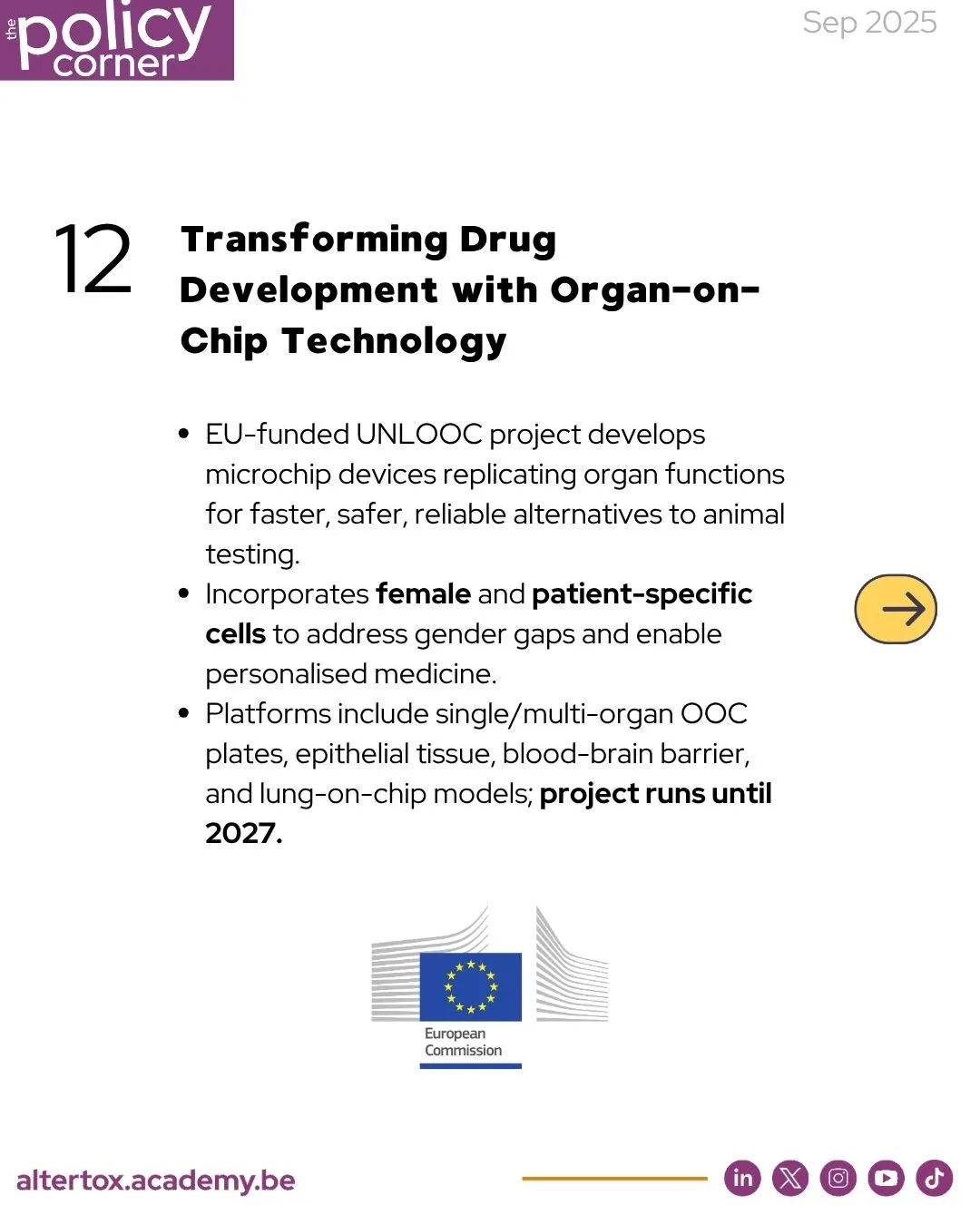
Transforming Drug Development with Organ-on-Chip Technology
- EU-funded UNLOOC project develops microchip devices replicating organ functions for faster, safer, reliable alternatives to animal testing.
- Incorporates female and patient-specific cells to address gender gaps and enable personalised medicine.
- Platforms include single/multi-organ OOC plates, epithelial tissue, blood-brain barrier, and lung-on-chip models; project runs until 2027.
Original slides (14)