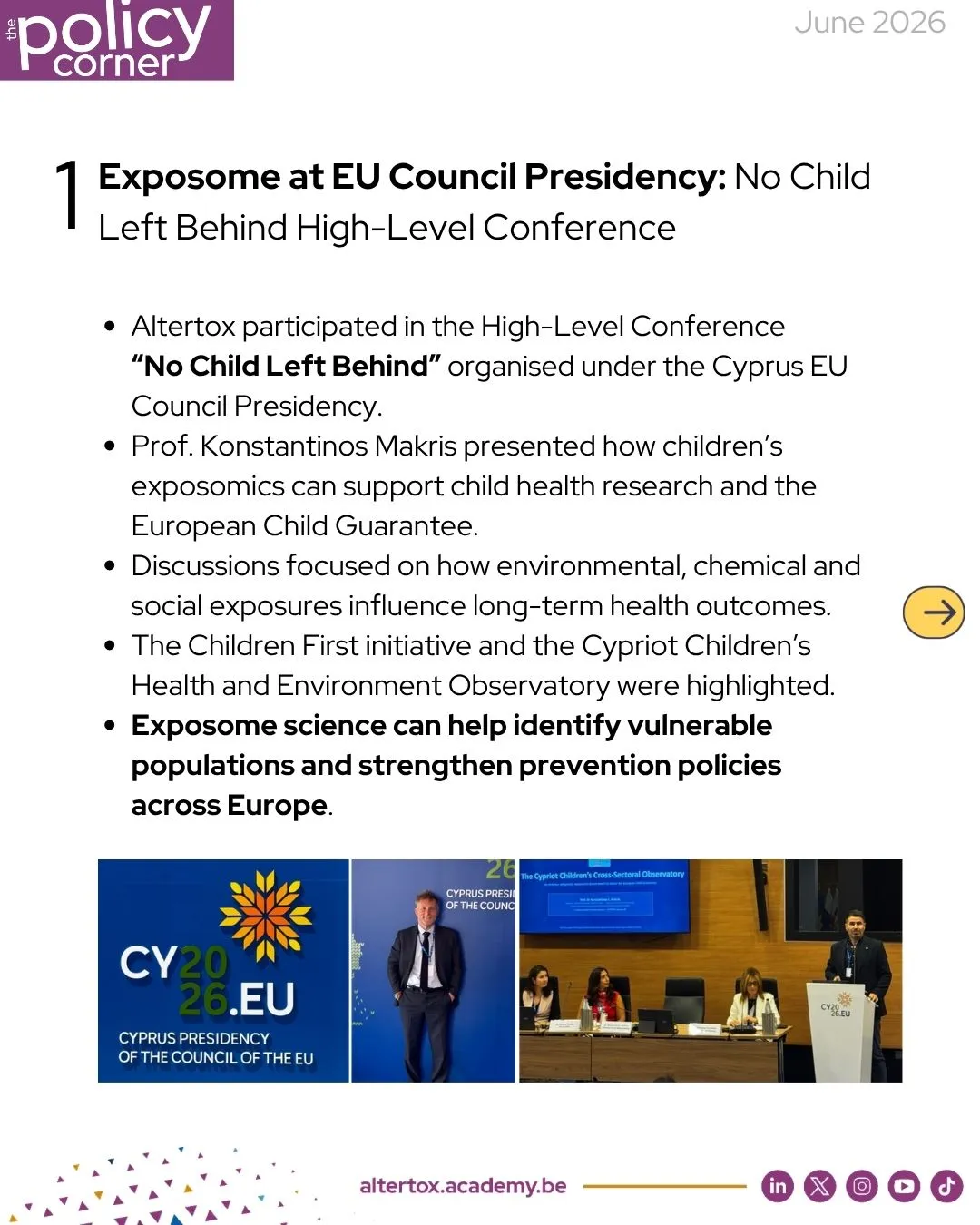
Exposome at EU Council Presidency: No Child Left Behind High-Level Conference
- Altertox participated in the High-Level Conference "No Child Left Behind" organised under the Cyprus EU Council Presidency.
- Prof. Konstantinos Makris presented how children's exposomics can support child health research and the European Child Guarantee.
- Discussions focused on how environmental, chemical and social exposures influence long-term health outcomes.
- The Children First initiative and the Cypriot Children's Health and Environment Observatory were highlighted.
- Exposome science can help identify vulnerable populations and strengthen prevention policies across Europe.
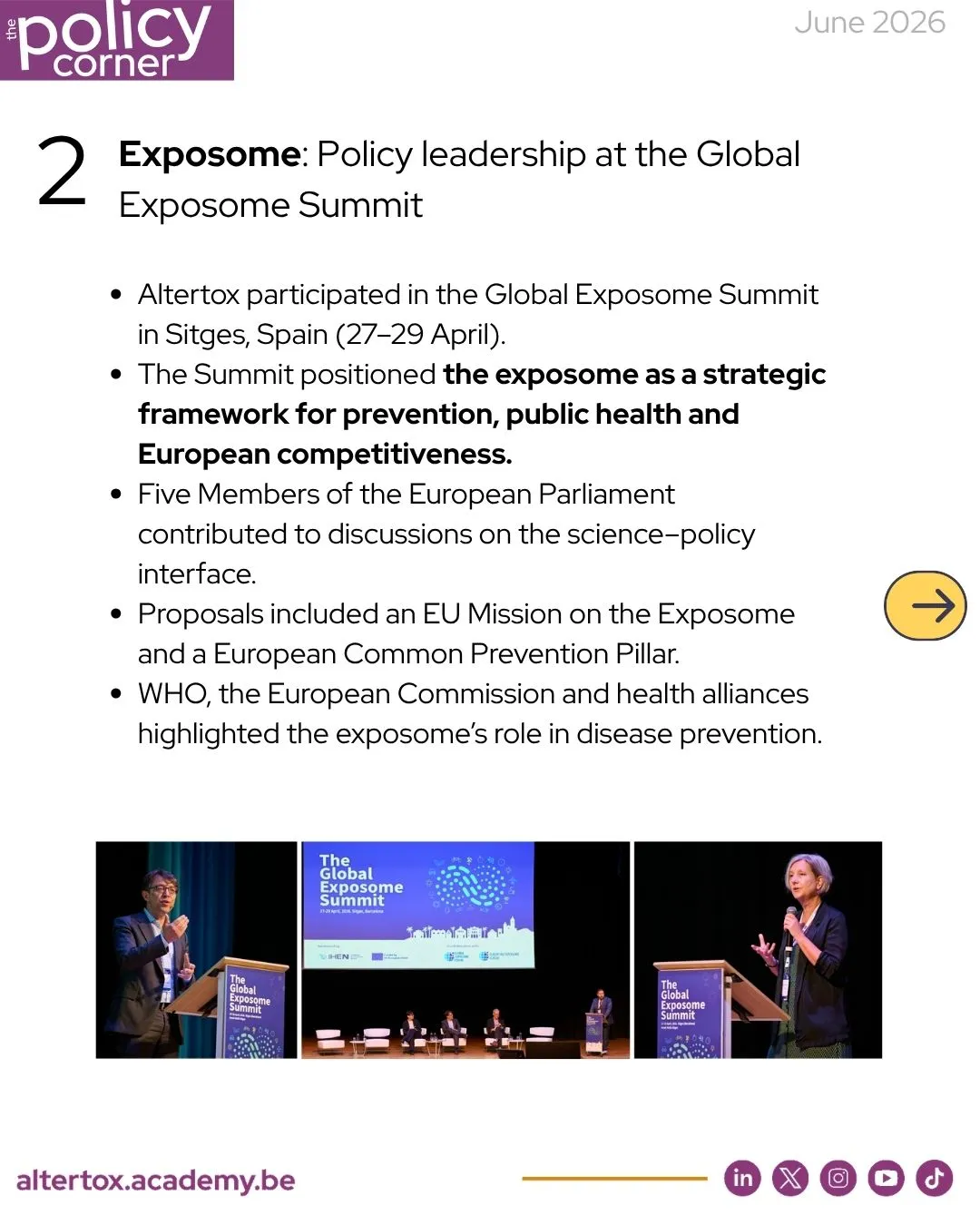
Exposome: Policy leadership at the Global Exposome Summit
- Altertox participated in the Global Exposome Summit in Sitges, Spain (27-29 April).
- The Summit positioned the exposome as a strategic framework for prevention, public health and European competitiveness.
- Five Members of the European Parliament contributed to discussions on the science-policy interface.
- Proposals included an EU Mission on the Exposome and a European Common Prevention Pillar.
- WHO, the European Commission and health alliances highlighted the exposome's role in disease prevention.
Chemicals: Commissioner Roswall's address at a Structured Dialogue with Members of the European Parliament's Committee for Environment, Climate and Food Safety (ENVI)
- Commissioner Jessika Roswall discussed the future of REACH at the European Parliament's ENVI Committee.
- The Commission concluded that it will not reopen REACH at this stage.
- Roswall emphasized the need for certainty and predictability for stakeholders.
- Work on simplification and stronger enforcement of chemicals legislation will continue.
- PFAS pollution remains a priority alongside support for innovation and safer alternatives.
Chemicals: Parliamentary question - E-001645/2026. Potential long-term neurological effects of artificial sweeteners and the need for an updated EU risk assessment
- MEP Krzysztof Brejza submitted a parliamentary question to the European Commission.
- The question references research linking higher sweetener consumption to faster cognitive decline.
- Emerging evidence on erythritol suggests possible effects on cerebrovascular function.
- EFSA currently considers authorised sweeteners safe within established intake limits.
- The Commission is being asked whether an updated risk assessment and additional risk communication measures are needed.
Chemicals: ECHA Science Seminar: Virtual Control Groups in Pre-Clinical Toxicity Studies
- ECHA hosted a science seminar on virtual control groups (VCGs).
- Experts from the VICT3R consortium presented the concept and regulatory qualification strategy.
- VCGs use historical control data to reduce reliance on concurrent animal control groups.
- The seminar highlighted progress toward regulatory acceptance of VCGs.
- Participants also explored the VICT3R database and its applications in safety assessment.
NAMs: Biotech Act I: accelerating the transition to non-animal science while advancing human health, environment and EU competitiveness
- A recent European Parliament event explored the role of NAMs in the future EU Biotech Act.
- Speakers highlighted organoids, organ-on-chip systems and AI-driven methods as innovative alternatives to animal testing.
- Discussions stressed the need for a clear definition of NAMs in EU legislation.
- Investment, research infrastructure, training and regulatory collaboration were identified as priorities.
- The Biotech Act was presented as a key opportunity to strengthen animal-free innovation in Europe.
NAMs: EURL ECVAM strengthens international collaboration on chemical safety innovation
- EURL ECVAM continues to expand international collaboration on non-animal safety assessment.
- Recent discussions with UL Research Institutes focused on chemical safety and digital tools.
- EURL ECVAM also engaged with GenoGra on genomics and next-generation safety assessment.
- Discussions centered on how cutting-edge genomic technologies can support next-generation safety assessment frameworks.
- Activities highlighted the growing role of computational biology and precision toxicology.
- The collaborations support more predictive and human-relevant testing systems.
NAMs: Lush Prize 2026 Winners Announced
- The Lush Prize 2026 recognised twelve winning projects and four commendations.
- Awardees from ten countries were selected by an independent judging panel.
- The prize celebrates innovation in ending animal use in research, testing and education.
- Winning projects advance animal-free science and ethical research practices.
- The initiative continues to promote the global adoption of NAMs.
Cosmetics: Call to renew membership of the Scientific Committee on Consumer Safety (SCCS) for the term 2027-2031
- The European Commission has opened applications for SCCS membership.
- The SCCS provides independent scientific advice to the Commission on consumer safety, with a particular focus on the safety assessment of cosmetic ingredients and chemical risk assessment.
- Applicants should have at least ten years of professional experience.
- Expertise in chemical safety, exposure assessment and hazard assessment is sought.
- Successful candidates will serve a five-year term beginning in January 2027.
Science to Policy: How Research Shapes EU Decision-Making
- Altertox works at the science-policy interface to support evidence-based decision-making on public health, chemicals, biotechnology and animal alternatives.
- We help translate complex research into actionable policy discussions.
- Our work connects researchers, policymakers, industry and civil society.
- Our policy activities include:
- Engagement with EU institutions and Members of the European Parliament
- Contributions to major EU regulatory and legislative initiatives
- Organisation of science-policy events at the European Parliament
- Leadership in initiatives on exposomics, NAMs and preventive health policy
- Explore our work, policy priorities and ongoing initiatives on our website
Original slides (12)