AI and Healthcare in Europe
- Altertox supported a meeting between Dr. Borys Brzezinski (SANT Committee) and Liesbet Geris (VPH Institute).
- Discussion explored collaboration opportunities at the intersection of healthcare and AI, and real-world AI applications.
- Laid foundation for future initiatives and dialogue to strengthen Europe's leadership in AI-enabled healthcare.
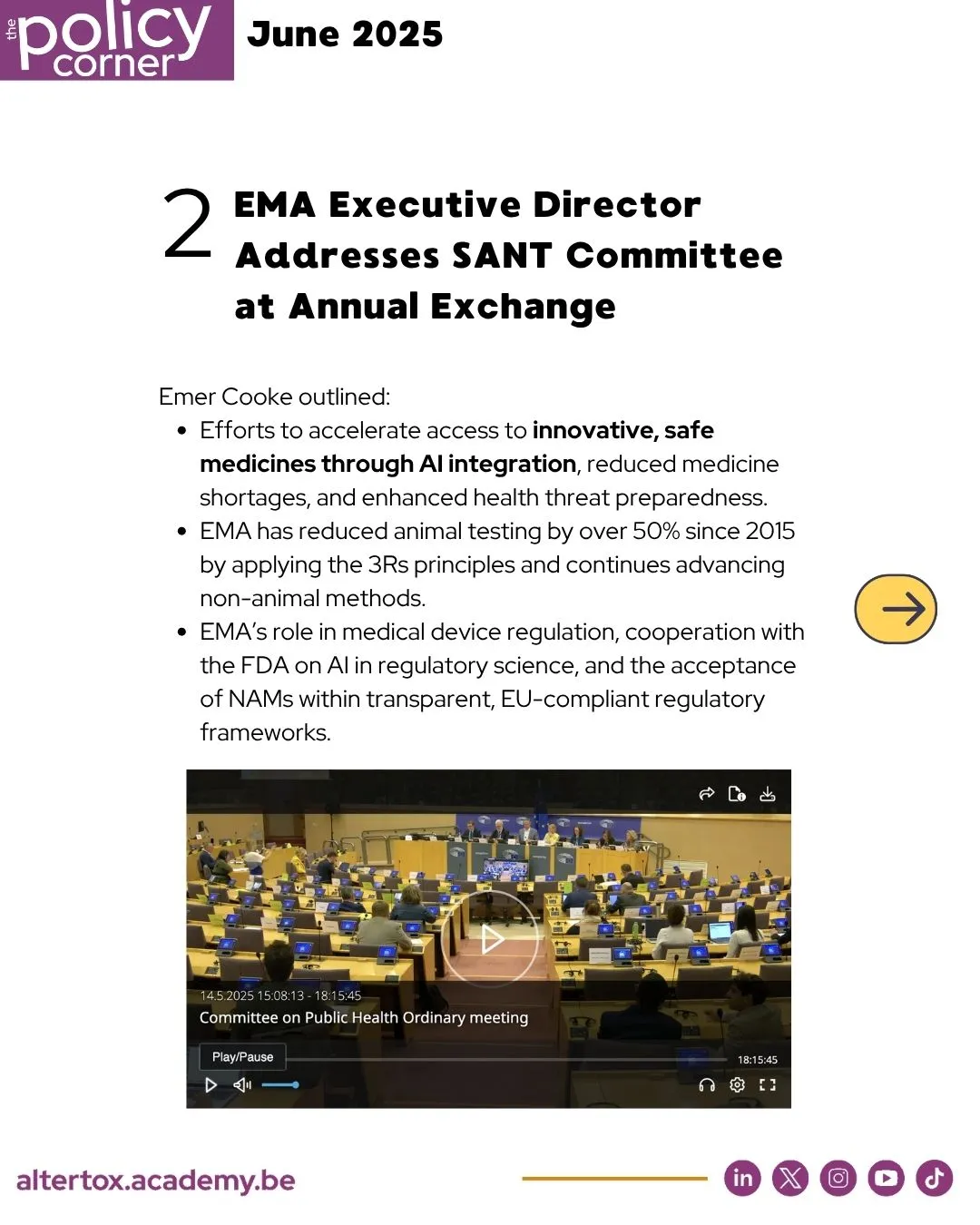
EMA Executive Director Addresses SANT Committee at Annual Exchange
- Emer Cooke outlined:
- Efforts to accelerate access to innovative, safe medicines through AI integration, reduced medicine shortages, and enhanced health threat preparedness.
- EMA has reduced animal testing by over 50% since 2015 by applying the 3Rs principles and continues advancing non-animal methods.
- EMA's role in medical device regulation, cooperation with the FDA on AI in regulatory science, and the acceptance of NAMs within transparent, EU-compliant regulatory frameworks.
AI and healthcare: a Euractiv Event
- EC Deputy Director-General Lorena Boix Alonso emphasized the need for simplification and competitiveness in EU health policy.
- She warned that rising costs of non-communicable diseases (NCDs) threaten both economic stability and human lives.
- Panelists stressed that patient-centred approaches are essential for successful AI integration, especially in addressing health inequalities and ensuring fair training data.
- The European Health Data Space (EHDS) is key to protecting data privacy.
- AI was highlighted for its potential to streamline clinical trials and support healthcare professionals.
Potential and challenges of human exposome research
- Exposomics examines combined physical, chemical, biological, and psychosocial exposures across the lifespan to understand their impact on human biology and disease risk.
- By identifying known and unknown environmental contributors to major diseases, the research supports a shift toward prevention, informing EU health policies and interventions.
- EU initiatives like EHEN, EIRENE, and IHEN are advancing exposome science, as highlighted in a new STOA study.
Parliamentary question E-001722/2025: Use of non-human primates in experiments and phasing out animal testing
- MEP Niels Fuglsang submitted a question to the European Commission regarding the continued use of non-human primates in animal testing.
- In 2022, 7,658 uses of non-human primates were recorded-up 9% from 2021-with France, Germany, and Denmark reporting increased use of species like baboons and vervet monkeys.
- Fuglsang asked what steps the Commission is taking to reduce and replace primate testing and specifically questioned ongoing practices in France, Germany, and Denmark.
Parliamentary question E-001720/2025: Continued use of guinea pigs in skin sensitisation tests
- MEP Niels Fuglsang (S&D) questioned the European Commission about the continued high use of guinea pigs in skin sensitisation testing.
- In 2022, 33,029 tests were conducted, with 78% involving guinea pigs, despite the availability of the less invasive Local Lymph Node Assay (LLNA) using mice.
- Fuglsang asked what actions the Commission is taking to promote the use of non-animal methods or, at minimum, encourage adoption of the LLNA across Member States.
Parliamentary Question E-001721/2025: Dogs being used in experiments and the phasing out of animal testing
- MEP Niels Fuglsang (S&D) questioned the European Commission about the use of 14,368 dogs in testing in 2022, noting a 9% decrease since 2021.
- France, Germany, and Spain were the largest users, while some Member States and Norway reported increases in dog testing.
- Fuglsang asked why dogs are still used under EU chemicals legislation and what measures are in place to reduce, replace, or phase out such testing, including for non-EU purposes.
Call for Evidence: The EU Biotech Act
- The European Commission is drafting the Biotech Act to speed up biotech innovation from lab to market while maintaining high safety standards for people and the environment.
- Biotech is a research-intensive, investment-heavy sector with a key role in the EU economy.
- Stakeholder feedback is open from 14 May to 11 June 2025, with a public consultation in late 2025.
- Adoption planned for the third quarter of 2026.
Is the FDA's plan to phase out animal toxicity testing realistic?
- The FDA's plan to reduce animal testing is backed by organ-on-chip advances.
- Lorna Ewart (Emulate) notes that challenges remain in expanding models, regulatory approval, and funding.
- Despite rapid progress, full adoption of these technologies requires continued cooperation among regulators, technology developers, and researchers to overcome existing barriers.
- nature reviews drug discovery
New Call: Comparing quantitative uncertainty of traditional versus NAMs based hazard characterization
- Cefic's LRI is funding a project to compare quantitative uncertainty in traditional animal-based vs. NAMs-based hazard characterisation, supporting the shift to Next Generation Risk Assessment (NGRA).
- The selected study will analyse 2-4 substances using both traditional and NAM-based tools through probabilistic and deterministic methods, enabling direct comparison of how safe exposure levels are derived.
- With a €250,000 budget and 1-year duration starting in Q4 2025, the project aims to inform regulatory frameworks through peer-reviewed results.
- Proposals due by 27 June 2025.
NIH to Prioritize Human-Based Research Technologies
- NIH aims to expand human-relevant research methods to reduce reliance on animal models and improve biomedical translatability.
- ORIVA (Office of Research Innovation, Validation, and Application) will oversee funding, validation, and regulatory efforts to support adoption of non-animal approaches across NIH programs.
- Grant reviews will include experts in alternative methods to reduce animal study bias.
- NIH will publish annual reports on investment in human-based research.
- NIH, National Institutes of Health Turning Discovery Into Health
Canada's Drug Agency's Position Statement on Use of AI in Evidence Generation
- Canada's Drug Agency (CDA-AMC) released a statement on using AI in generating and reporting evidence for health technology assessment (HTA).
- The statement, based on NICE's work, stresses transparency, rigor, and prudent AI use-only when it clearly adds value.
- Goal: to ensure AI-supported evidence is appraisable by CDA-AMC and external bodies, enhancing clarity and accountability in HTA.
European Medicines Agency 30th Anniversary Scientific Conference
- On 25 June 2025, EMA will hold a scientific conference titled "Medicines, Regulation and the Future" to reflect on achievements and future directions in medicine regulation.
- The event will bring together key European stakeholders to discuss advancements in the field.
- Professor Thomas Hartung will present on alternatives to animal testing, including organoids and AI, highlighting EMA's commitment to innovative and ethical regulatory science.
Original slides (14)